
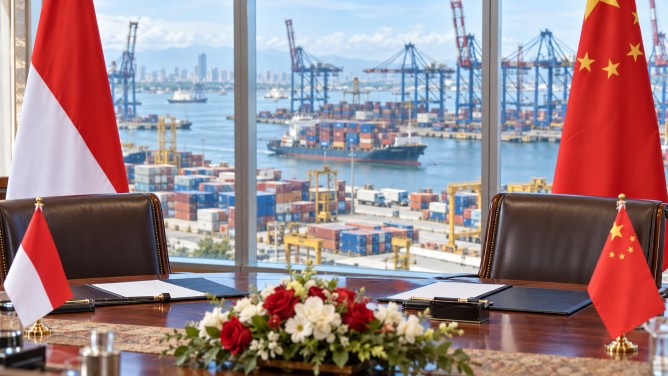
Indonesia and China are enhancing their economic collaboration, with bilateral trade reaching $154 billion, a significant increase from approximately $8 billion. This growth in trade underscores expanding cooperation in areas such as investment, technology, and sustainable development.
During a forum in Jakarta, former Indonesian Ambassador to China Sudrajat noted the rapid increase in trade, highlighting that by 2010, bilateral trade had reached $20 billion before climbing to its current level. He emphasized the importance of coupling strong economic ties with closer people-to-people relations and cooperation that benefits local communities. Sudrajat identified disaster management as a promising area for collaboration, given Indonesia’s frequent natural disasters, suggesting that China’s experience in disaster prevention could bolster Indonesia’s capabilities.
Beyond trade and investment, Indonesia-China cooperation is expanding into the digital economy, artificial intelligence, renewable energy, and green development. Guan Kejiang, a Chinese media executive, pointed to opportunities to align China’s development priorities with Indonesia’s Golden Indonesia 2045 Vision, aimed at transforming Indonesia into a developed economy by its independence centenary. He also stressed the importance of regional stability and international cooperation amid geopolitical tensions and rising protectionism.
Chinese diplomat Zhou Kan described the two countries as influential developing economies and important members of the Global South. Both nations actively participate in international forums, including BRICS, the G20, and the Asia-Pacific Economic Cooperation (APEC) forum. Zhou noted that bilateral relations have strengthened through increased political trust, deeper economic integration, and growing cultural exchanges.
Indonesian investment adviser Noor Sona Maesana Mushonnif highlighted the benefits of the comprehensive strategic partnership, particularly for Indonesia’s mining, electric vehicle, and manufacturing sectors. He advocated for further cooperation in renewable energy, agriculture, maritime industries, and high-value-added manufacturing. Discussions at the forum underscored both nations’ interest in broadening their partnership beyond traditional trade by emphasizing technology, sustainable growth, industrial development, and regional cooperation.